Investment Casting Production Process
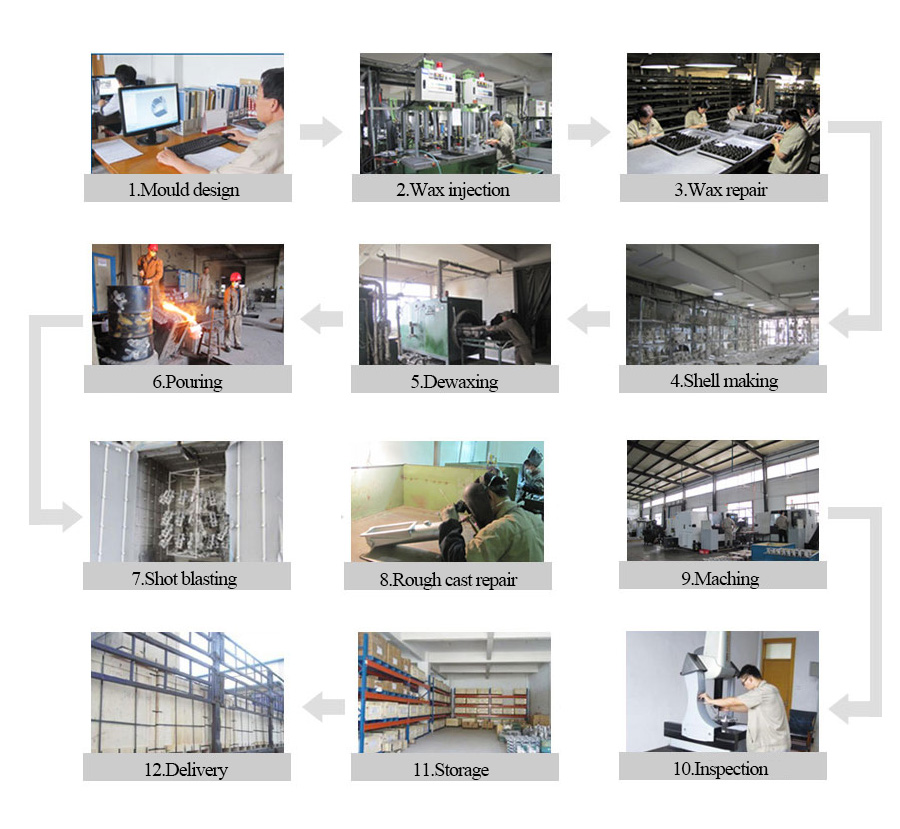
Senjia Casting uses the silica sol lost wax casting process to manufacture custom metal casting parts according to customer drawings, samples and technical requirements.
This process is suitable for stainless steel, carbon steel and alloy steel parts with complex shapes, detailed structures and stable dimensional requirements. Each project is reviewed before production according to material grade, part structure, wall thickness, tolerance requirement and surface treatment requirement.
Before production, we review the customer’s drawing, material grade, quantity, tolerance requirement and application. This step helps confirm whether the part is suitable for investment casting and whether any casting risk should be considered before mold development.
After the process review, the mold is developed according to the confirmed part structure and production requirements. Good mold preparation helps improve wax pattern consistency and production stability.
Wax patterns are produced according to the final casting design. Each wax pattern should be checked for shape, surface condition and key dimensions before assembly.
The wax patterns are then connected to a central runner system to form a wax tree. Wax tree assembly affects metal flow, shell coating, mold filling and casting quality, so gate position, pattern spacing and tree balance must be properly controlled.
The assembled wax tree is repeatedly dipped into ceramic slurry and coated with refractory sand to form a ceramic shell. In silica sol investment casting, shell quality has a direct influence on surface finish, dimensional stability and pouring performance.
The shell must be dried under suitable conditions before the next process. Stable shell making helps reduce cracking, deformation and surface defects.
After shell making, the wax is removed from the ceramic shell. This creates the internal cavity for metal pouring.
The shell is then fired at high temperature to improve strength and remove remaining moisture. Proper dewaxing and shell firing help prepare the shell for stable metal pouring.
Stainless steel, carbon steel or alloy steel is melted according to the required material grade. Before pouring, material and process requirements should be confirmed according to the drawing and application.
Molten metal is poured into the prepared ceramic shell under controlled conditions. Pouring temperature and process stability are important for reducing defects such as porosity, shrinkage and incomplete filling.
After cooling, the ceramic shell is removed and the casting parts are separated from the gating system. The parts then go through cutting, grinding, shot blasting or other surface cleaning processes according to product requirements.
Surface treatment such as polishing, passivation, pickling, sandblasting or other treatments can be arranged according to the application and appearance requirements.
Final inspection is arranged according to customer requirements and product application. Inspection can include chemical composition analysis, dimensional checking, surface inspection, hardness testing and other tests if required.
After inspection, the parts are packed according to export requirements and prepared for delivery. For accurate quotation, customers can send drawings, material grade, quantity, tolerance requirements and surface treatment requirements.
Contact: Terry Zhang
Phone: +86-13515399527 (Whatsapp/wechat)
E-mail: zhang@senjiagroup.com
Add: No 106 Jinqueshan Road, Linyi, China